When I think of canals, I always think of Venice and the long oars of men in striped shirts and funny hats rowing tourists along calm waters and under bridges. It’s all sculptures, and scenes from Cornelia Funke’s The Thief Lord, a favorite of mine when I was younger. But on this trip, I experienced canals across 3 different countries, with people speaking 2 different languages (4 dialects), and not a single one of them was Italy or Italian.
This year, we kicked off the summer with yet another Europe trip, and found ourselves in an area I’d never really thought about: The Low Countries. Now, that’s not a derogatory term for countries of a lower rank or station, but rather a literal description of the fact that much of Belgium and the Netherlands is actually below sea level. The descriptor is so apt in fact, that the modern name of “the Netherlands” is simply another way of saying Low Land. We found canals in both countries, and just to top it off we even re-visited the Grand Canal in Versailles for a day! So here it is, our trip to France, Belgium, and Amsterdam.
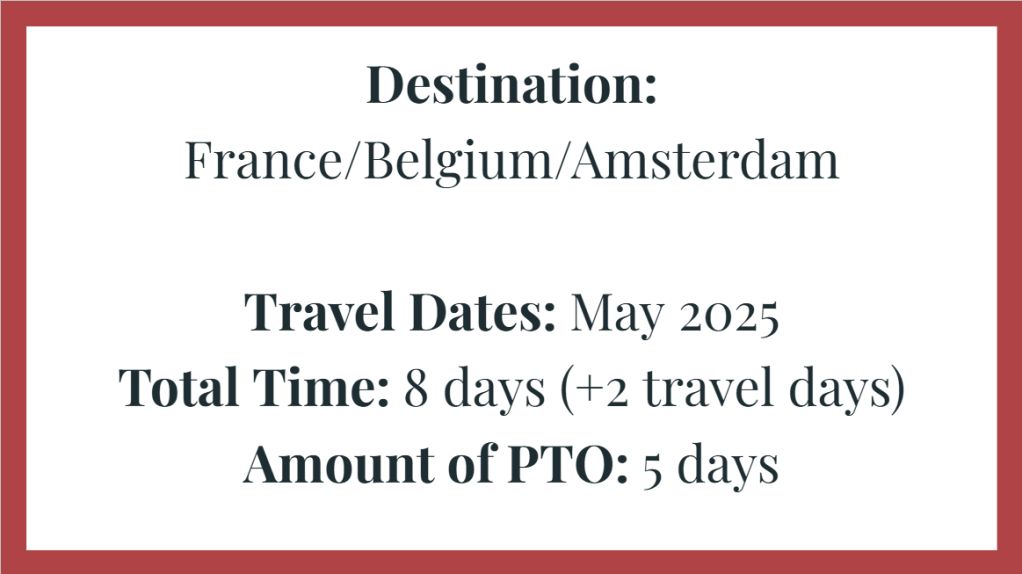
The Itinerary:
| Day | Activity | Recommended Amount of Time |
| 1 | Gardens of Versailles Sacre Couer Basilica | 5 hours+ 1 hour+ |
| 2 | Exploring Brussels | 4 hours+ |
| 3 | Antwerp Walking Tour | 2 hours+ |
| 4 | Exploring Bruges Exploring Ghent | 1-3 hours 1-3 hours |
| 5 | Choco-Story The Atomium & Mini Europe Exploring Amsterdam | 1 hour 2 hours 2 hours+ |
| 6 | Amsterdam Canal Tour Sea Palace Restaurant Anne Frank Walking Tour Anne Frank House | 2 hours 2 hours 2 hours 2 hours |
| 7 | The National Maritime Museum Hortus Botanicus The Red Light District | 2 hours 1 hour+ 1 hour+ |
| 8 | Rijksmuseum Van Gogh Museum Vondelpark | 2 hours+ 2 hours 1 hour+ |
Travel:
I’m always a big fan of efficiency, but one thing that trumps time-efficiency in my mind is cost-savings. For this trip, we were able to cut down our budget substantially by using the EuroStar trains and other rail systems across Europe. There was one small downside: it took us forever to get to the start of our trip. Our cheapest option was round-trip flight tickets between Boston and Brussels, though if you look at the itinerary Brussels was neither or first or last stop.
So we set off on a flight from Boston to London, then London to Brussels. We used the local Belgian transit system to transfer from the airport to the train station, then took EuroStar to Paris. This was another round-trip ticket, because we took the same train in the opposite direction on our return to Brussels. Later in the trip, we took a EuroStar from Brussels to Amsterdam and returned on the same route on our last day, followed by another local transfer to the airport and return flights via London. A bit clunky, to be sure, but this round-about way of travel actually afforded us more opportunities to explore!
With a trip so circular in its travel, it makes the most sense to present the information by country, and so that is how I have organized this article. We split up our days as described in the table above, but all of our memories are certainly organized by location. And oh the places we went!
Country #1: France
I know, I know, we were just here in January! Not only did we make our way back to France, but we stayed in Paris and visited Versailles all over again. While I am a big proponent of seeing Europe in the winter (after all, it’s less crowded and still warmer than Boston), there are some things you just can’t get in the off-season. One of these is the musical fountain show at Versailles. In this show, they open up all the groves (or as many as they can, depending on if any maintenance work is ongoing) and set the fountains to beautiful baroque music. It’s a must-see experience if you’re in France during the spring and summer. To see details of what dates and times the show runs, visit the Chateau de Versailles website.
Getting There:
The best way to get to Versailles from Paris is to take the RER train system. Use Google Maps to determine the best route from your location – there are multiple trains that go between Paris and Versailles. There are 2 train stations in Versailles accessible by the RER. If you prefer a shorter walk, go to Chateau Versailles Rive Gauche. This is a smaller train station that is designed to take you to the palace and gardens, and is often full of tourists. When you exit the station, you’ll find clear signage pointing in the direction of the Palace. It’s about a 15 minute walk to the main entrance where they’ll scan your tickets, and you’ll get to walk along a section of the Avenue de Paris which has a nice view of the palace and a well-maintained bicycle and walking path.
The other option is to take the train to Versailles Rive Droite, which is a larger train station and seems to be where locals transit to go into the actual town of Versailles. Your walk from here to the palace is less clearly marked, though easy to navigate following Google Maps. It’s a 20 minute walk, and while you won’t see the bike path along Avenue de Paris, you’ll still get the view from down below the palace. In exchange for Avenue de Paris, this route takes you through the modern town of Versailles, and while this section of town is still very tourist-catered, it’s a little more “slice-of-life”.
Make sure you keep a little gas in the tank though, the actual visit to Versailles takes a lot of walking and you’ll need to make the walk back to the train station too. If you’re planning to do the palace and the gardens, expect to walk anywhere from 5-10 miles depending on whether you want to add in the Petit and Grand Trianon estates, and how much of the gardens you want to see. For the gardens alone, we walked through every single grove and stopped at the head of the grand canal, which took us to nearly 4 miles (including the walk back out). For us, that’s a fantastic day! But it’s always worth knowing what you’re getting into so you can fuel yourself accordingly. There are little restaurants in a few of the groves in the spring and summer, as well as kiosks that sells coffee and sandwiches in the winter.
Highlights:
If you’ve never been to Versailles, the Palace is a must-see event. Take a look at my previous post about Paris for ideas on what to see other than the Gardens. For us, we wanted to catch what we could not see in the winter: The Gardens. With a neat, geometric layout, the gardens are easy to explore and maps are available at the entrances and exits to each grove. Remember not to skip alleyways just because they seem repetitive. Many of these alleyways are adorned with beautiful statues, trees that are practically sculptures themselves, and small fountains painted in gold and other colors. While the winter means turning off the water, most of the statues also get covered up to protect them from the harsh climate. So this was a first-time viewing for us on most of these features.
We ventured through every grove the day we visited, and found that we had some clear favorites. The Salle de Bal (ballroom) cannot be missed. Particularly with the addition of the musical show which highlights the acoustic features of this creative and complicated work of landscape architecture. I highly recommend the 2014 film A Little Chaos, in which Kate Winslet plays a fictional assistant to the actual artist behind this grove. The film provides some context as to why the grove is a particular work of art, and the challenges faced during construction. Of course, there is also some salacious French court drama pulled right out of the history books to add a little intrigue in the mix.
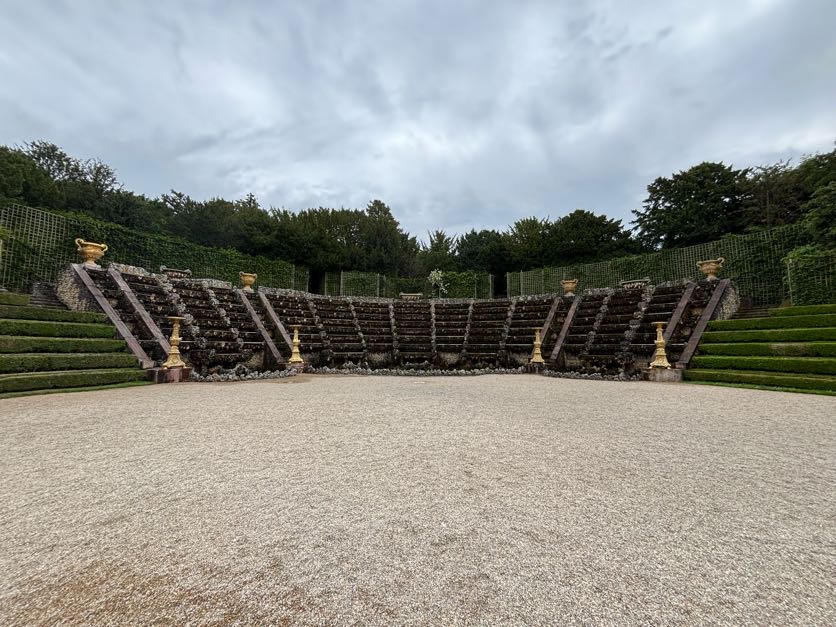
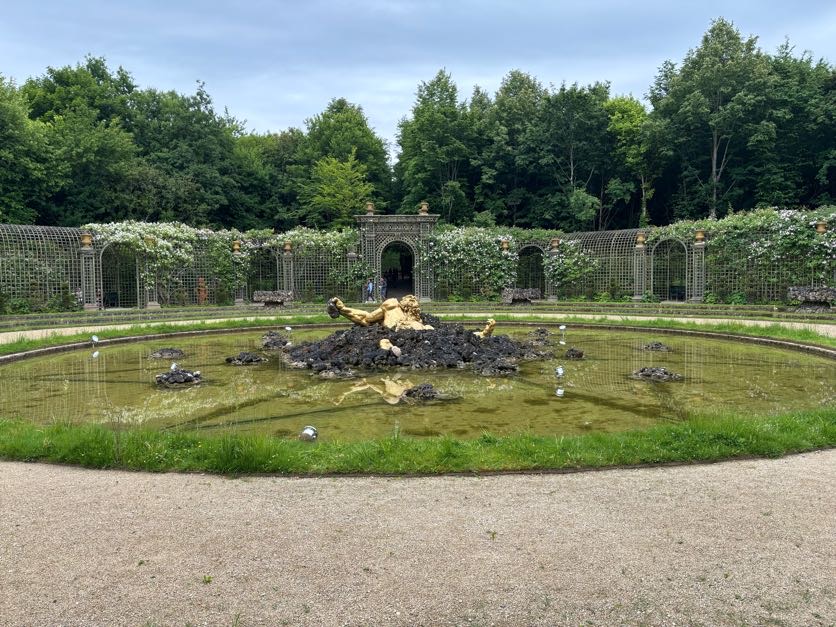
In the Bosquet des Bains d’Appollon you can crane your neck and see how many statues you can count in the ornate scenery, and the Bosquet des Trois Fontaines is the perfect backdrop for a photo. I’d encourage you to do the full circuit of groves to get a real feel of the place. If you find yourself in a hurry, you can prioritize those with water features. The Bosquet de L’encelade was a personal favorite for us both, boasting an impressive statue at the center of the fountain, and a beautiful walkway all the way around.
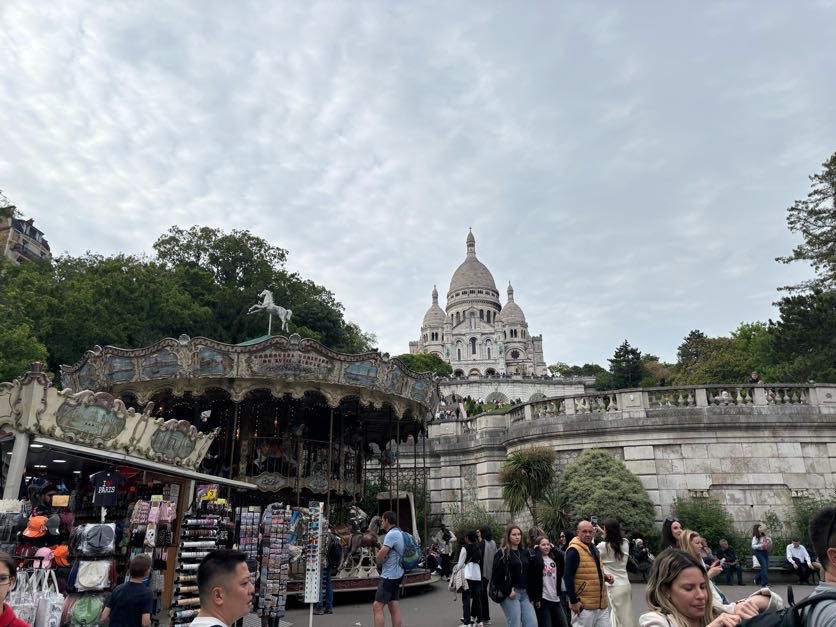
On the return to Paris instead of heading straight to our hotel, we took a little detour to the artistic Montmartre neighborhood. This neighborhood is in a particularly hilly area and features a long windy road, or steep staircase, to the top of the Sacre Couer basilica where you can enjoy a panoramic view of Paris. If you choose to go here, be extra mindful of your belongings as this is a hotspot for pickpockets. Other than that though, it’s a gorgeous overlook and a really beautiful basilica as well.
Fueling Up:
As I said before, this is quite a walking intensive activity. Generally, European vacations are pretty walking intensive across the board, so its important to find food along the way. For emergency snacks, there are kiosks in the gardens and small stall restaurants inside some of the groves. These serve soft drinks, alcohol, and light meals such as sandwiches. When it comes to quality though, France has far more to offer, and I would not advise stopped at these locations for a full meal. The Palace of Versailles features multiple sit down restaurants where you can get a proper French meal. Our personal favorite wasn’t French at all though. La Petit Venise is a wonderful Italian restaurant tucked in a corner by the Grand Canal. Here we had a meal we didn’t mind paying full price for (and honestly, it wasn’t even overpriced despite being on the grounds of Versailles!)
We also had some meals in Paris during this leg of our trip. While seeing Paris was not the priority this time around, we had breakfasts and dinners in the city during our stay. For breakfast, I recommend the nearest boulangerie. Be careful to walk a few blocks away from tourist attractions and major train stations (not including metro stops) before you pick a place, since restaurants aimed at tourists seem to often serve a lower quality meal at a higher price in Paris. For dinner of course, we went to Le Suffren, a fan favorite from our previous trip. Unsurprisingly, it provided us with just as amazing a meal as we had last time, and made for the perfect conclusion to our time in France.
Country #2: Belgium
Getting There (and Getting Around)
Despite focusing our France trip on just one priority location, we took the opposite approach with Belgium and covered 4 different cities during our visit. The best place to stay in Belgium (at least, out of the places we saw) is certainly Brussels. This proves a central hub for getting around the country, and frankly has the most lively areas to explore even after dark. It’s also a central hub of activity for the European Union, which means flying in and out is very convenient. If you’re coming from a nearby European city (like Paris or Amsterdam, as was the case for us) you can take the EuroStar to Brussels Midi/Zuid station.
It’s important to remember that Belgium is a multilingual country. In Brussels, you’ll be able to communicate with most people in English and will often find signage is easy to follow. Across the country, the main languages spoken are French, Dutch, and dialects of each. So when you buy tickets for Brussels Midi, you may have to get off the train at Brussels Zuid, as these are the same station with separate names for each language. Track down the French and Dutch names for each location you are going. Some of these will be easy to spot (Central vs. Centraal), while others might be more confusing.
To get from Brussels to other cities in Belgium, you can take the local train system from any of the major Brussels stations (Nord, Central, Zuid). Purchase a round-trip ticket from a kiosk at the station before you board the train. I would generally advise against purchasing a first-class ticket. On the train, first-class and second-class seats are marked by large numbers at the entrance to the car or on the wall next to the section of the train. We noticed that while the first-class seats were slightly larger and had upgraded headrests, they were not so much nicer as to warrant the additional ticket price. In fact, the second-class seats were quite spacious and comfortable.
When buying a ticket on the kiosk, you will indicate your station of origin and your station of destination. This does not tie you to a specific train number or route, so you’ll have to check the board and see the list of stops for any given train to determine if you’re getting on the right one. If you’re going to two cities in the same day (such as Ghent and Bruges), buy a round trip ticket for whichever city is further down on the line. You can get on and off the train as many times as you want throughout the day, so if you’re going from point A to B, you can get off half way through the journey and get back on another train later to complete the trip. The SNCB website is a good resource to read before using trains in Belgium. It’s not very complicated, but it helps to take a quick read-through!
If you’re traveling locally within the same city, you can take the tram or bus. Tap-to-pay is available on local transit options within all cities in Belgium, and Google Maps has a good understanding of the local transit systems and their stops. It is not necessary to download any additional apps to effectively use transit in Belgium.
Highlights & Fueling Up: Bruges
The city of Bruges (or Brugge) is either named after, or perhaps might be the namesake of, the bridge. This is a city of canals much like you might picture Venice or Amsterdam, but with fewer straight lines. The train station that you will arrive at is approximately a 20 minute walk from the center of town, and I would encourage you to start the day with a canal tour. These tours feature a small boat that winds through canals, passing under bridges that are so low you might have to duck! The tour guides add humor to their explanations, and point out various landmarks. It’s a nice way to start a day in Bruges as it gets you acquainted with the city and may give you ideas on what to see.
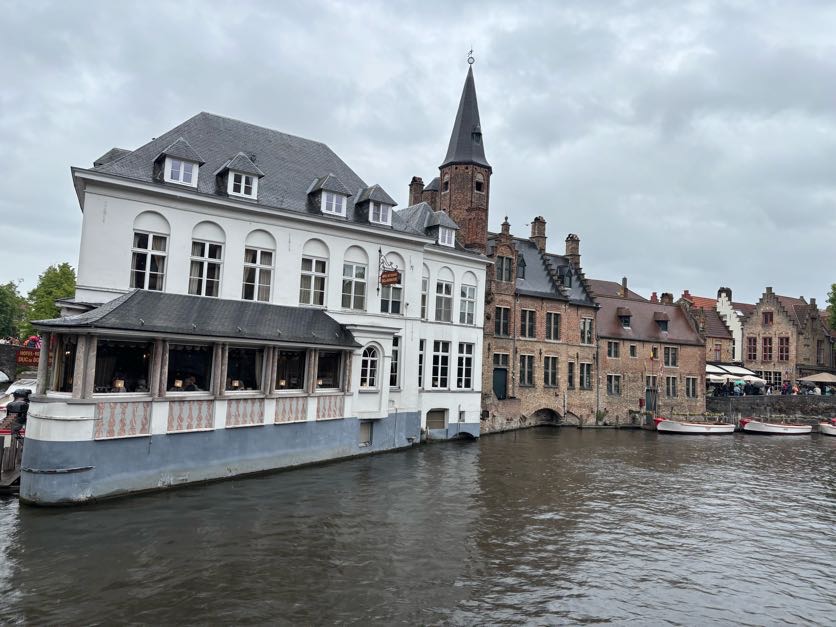
The main activity in Bruges is really just walking around. There are several museums that you may want to visit depending on your interests, as well as a brewery that provides a tour. My personal favorite point about the brewery is that you could smell it both on land and in the canal. So if you enjoy the wonderful smell of malt, I highly recommend at least passing by this building. There are tons of restaurants all around the center of the city, often with views of the canals. I recommend trying mussels and fries, a class Belgian dish, while you are here.
To be honest, we were a bit let down by Bruges. Despite its prominent feature in the film In Bruges and raving reviews of the city across different tourism websites, we thought it was smaller and less impressive than we were led to believe. Here’s the thing: Bruges will make for a wonderful addition to your trip because it is quaint, has beautiful canals, and well-loved cobblestone streets for you to walk on. Budget yourself 1 hour of free time to explore the city, and you’ll have an amazing time. Just don’t go there expecting to be wow-ed by medieval architecture and feel like you’ve been touched by the ancients. The same city in America might have that effect, but in Belgium we were surrounded by medieval architecture 24/7 and Bruges did not impress when our expectations had been set so high.
Highlights & Fueling Up: Ghent
As far as expectations vs. actuality, Ghent (or Gent) was similar to Bruges. We expected too much, and when we got something wonderful that was less than our expectations, we had trouble appreciating it. We also got hit by an absolute downpour of rain while we were there, so that certainly put a bit of a damper on the trip.
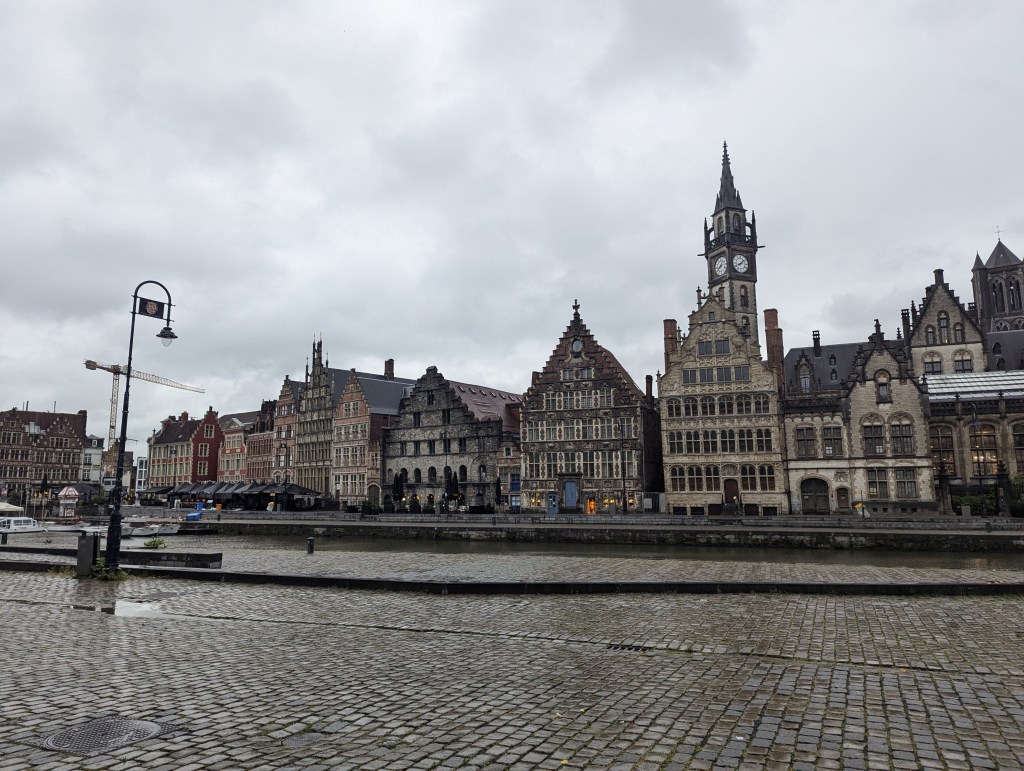
Like Bruges, the city center is about 20 minutes walk from the train station. Unlike Bruges, this city features an exciting side quest: a university. Though we didn’t get much of a chance to explore it in the rain, the University of Ghent campus is right next to the train station. The existence of the university means that this city has a little more liveliness to it as well. Our personal favorite spot was where we fueled up: Dulle Griet. This pub, located on the Vrijdagmarkt square, will serve you a giant sized beer in exchange for your shoe – a gimmick that many tourists had come in here to see. I’m not always fond of the tourist-trap gimmick, but this one actually was quite fun. The beer in Belgium is undoubtedly good, and while the quantity was good for 2-4 people (depending on their alcohol tolerance), it came with a healthy dose of fun.
Before leaving Ghent, be sure to also take a visit to Citadelpark. Despite being a small park in relation to Central Park, the Gardens of Versailles, and many other famous green spaces, it did an excellent job of making you feel totally removed from the city. We arrived in the park just as the rain had died down and found ourselves in a cool, green area. As you walk along the paths you feel like you’re in a vast forest, but you never find yourself lost or too far from the nearest road to get your bearings again. The park is a perfect way to end your day in Ghent as it brings you right back to the train station.
Give yourself more time in Ghent than you do in Bruges. The distances between things you’ll want to see are a little bit larger, and with a university-town feel it is certainly nice to have a little extra time to explore. We unfortunately missed one of the main attractions in Ghent, though seeing it from the outside makes me want to go back and take a look. Gravensteen (Castle of the Counts) is a medieval castle, complete with a moat, that supposedly contains an armory museum and viewpoints that provide a panoramic view of the city.
Highlights & Fueling Up: Antwerp
Antwerp is one of the most historically critical locations in Belgian history, being a key port city that made this a hub of economic growth. Now known primarily for the diamond industry, which is still largely based out of Antwerp, it has historically been home to the trading ports for many other industries. Because of this historic and current purpose to this city, it’s not as fun a spot to just walk around. There are fewer blatant tourist attractions, and the space is more geared towards industrial function than idle wandering by tourists. That being said, it’s still a beautiful medieval city and absolutely worth a stop. Add Antwerp to your trip as a day or half-day adventure.
We explored the city primarily through a free walking tour. These were a great way to see a lot of Europe as the guides were well-informed and the tours were easy to come by. Wherever we used a free walking tour, we tried to leave ourselves free time afterwards to revisit locations that we felt we needed more time with, or enter buildings that we only got to see from the exterior. The best part of the tour was discussion of the origins of Antwerp, which are inextricably caught between historical fact and myth. We also enjoyed a visit to Het Steen, a medieval fortress on the river which now provides a tower with a 360 view, a small museum about the city of Antwerp, and a wonderful gift shop.
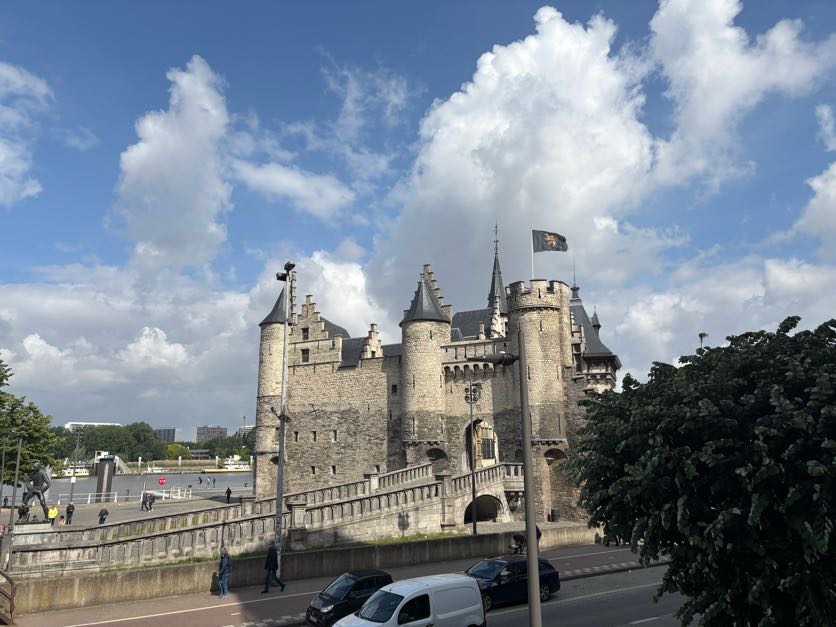
Food options were limited compared to other cities – possibly because we were visiting in the middle of a work day. We stopped for a waffle from a stall on the street, which was deliciously decked out with Nutella. For lunch, we stopped an adorable bistro called ‘t Hofke which was hidden away behind a small alleyway called Vlaeykensgang which we passed through on our walking tour. There are also multiple food options in the Antwerp train station which can provide a snack or drink in a pinch.
There were several other attractions that we didn’t hit, specifically museums that pertained to the city’s history. One in particular that sounded interesting was of an old printing press that operated one of the first newspapers in the city, with other museums devoted to the city’s ties to the famous Flemish artist Peter Paul Rubens. The Antwerp Zoo is also supposed to be a good one, with statues of large animals outside which you can view for free without entering the zoo. Most importantly, make sure you take your time to appreciate the beautiful Antwerp train station before you leave the city – it is truly an amazing structure!
Highlights & Fueling Up: Brussels
Now we get to the absolute highlight of our Belgium trip: the capital city of Brussels! I recommend staying in a hotel near the Brussels Centraal station as this is in the historic center of the city. That puts you smack in the middle of where most of the tourist attractions are, as well as a lot of good food. Some particular favorites for meals were ‘T Kelderke, De Gulden Boot, and Ballekes. The first two are restaurants right in the city’s Grand Place and if you enjoy dinner here you’ll watch as the Place is lit up after sunset. Ballekes is a chain restaurant, however they serve amazing meatballs that are absolutely worth the visit!
We made a specific visit to Choco-Story, a museum that explores the history of chocolate and how it was transported from its native environment to the modern idea of lush Belgian chocolate. This is sort of a chain museum, and you can visit it in any of the major Belgian cities. The best way to explore Brussels however, is to simply walk around. A free walking tour is a good idea if you want to make sure you hit all the key points and visit all the famous sculptures on the street, though in our case we had a ton of fun just wandering around the Grote Markt (or Grand Place) area. If you’re a lover of parks, take a stroll through the Parc de Bruxelles.
On our final day, before heading out of the country and into the Netherlands, we took the short trek on the subway to BruParck. This is a large complex built around the iconic Atomium, a large sculpture-building that was originally constructed for the 1958 Brussels World’s Fair. In addition to the Atomium, the space also features Kinepolis and Mini Europe. We skipped Kinepolis as we didn’t have enough time for a movie during our visit, however we were able to buy a combined ticket for the Atomium and Mini Europe. The Atomium is about a 45 minute tour, but note that there is sometimes a line to enter. Mini Europe takes about an hour to walk through, though it can be a 30-minute speed-run if you’re in a hurry.
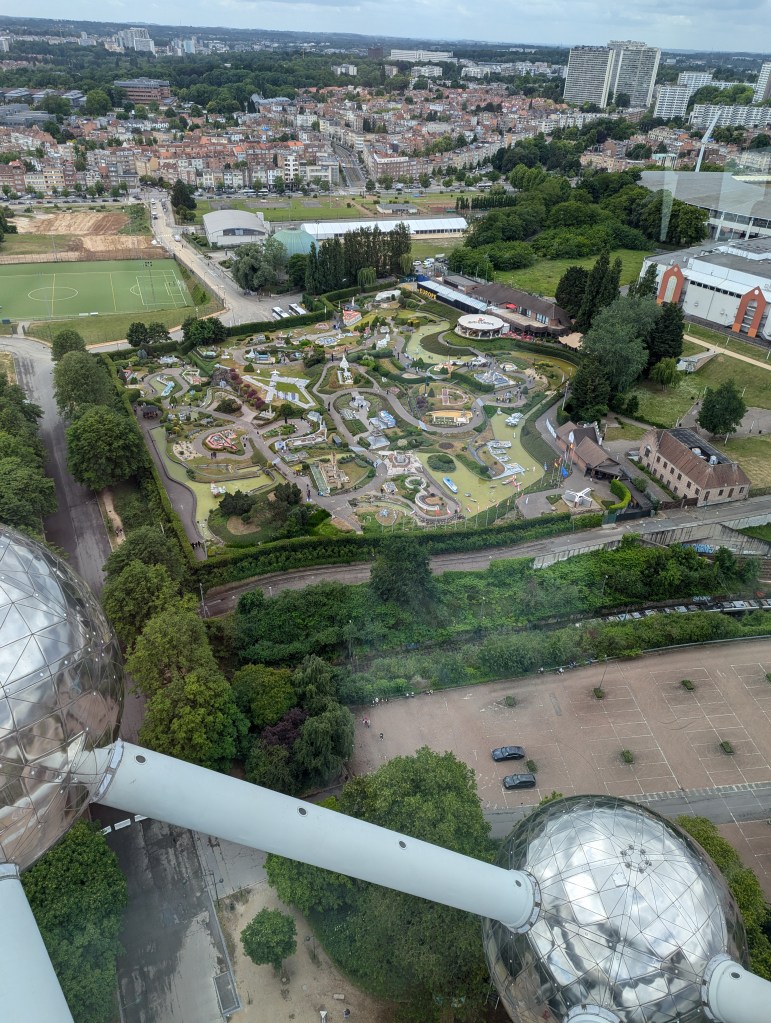
We really enjoyed our visit to Mini Europe, where we got to stand near a miniature of many of the buildings we had seen on our trip so far, including the Eiffel Tower and the Sacre Couer Basilica! This is an effort by the EU to improve education on what the European Union is, promote the various sites around the entire Union, and educate school children on the benefits of the EU and how it helps each member-country. For us tourists, it’s an excellent miniaturization of many sites you will see on European travels.
Conveniently, there’s a direct connection from the Brussels Midi/Zuid station to Mini Europe by subway, making this an ideal stop at the end of your trip. Luggage lockers are available at the Midi/Zuid station where you can deposit your luggage before you head to Mini Europe, and then pick up your belongings on time to catch a train to your next stop!
Country #3: The Netherlands
Getting There (and Getting Around):
Using the trusty EuroStar, the trip from Brussels to Amsterdam was a quick journey. We grabbed some food in the train station in Brussels before we left and kept ourselves fueled through the train ride. Exiting the Amsterdam Centraal station we were first taken by the wonderful view of the IJ, the Amsterdam waterfront, and secondly noted that there were no longer any signs in French. Making our way to the hotel, we noted that the city is quite small and highly walkable – though watch out for cyclists!
It’s definitely a bit of a challenge navigating cars, cyclists, above-ground trams, and other pedestrians, but after a day or two we found ourselves zipping through the streets with ease. The city is small, but there’s a ton to see and we felt that our three days there were barely enough. We got around almost exclusively by foot, and took the tram system only on our final day to return to the train station to catch our EuroStar back to Brussels.
Highlights:
We had the evening free when we first arrived and used the time to wander around somewhat aimlessly, which is really something I hope to do in every city I ever visit. It’s the best day to just get a feel for what the place is about. On the second day, we kicked off the official site-seeing with a canal tour. We didn’t go in for the eating and drinking tours as these cost extra and we were really just interested in the view and a little bit of information. With some rain forecast for that day, we did ensure that we had a covered boat.
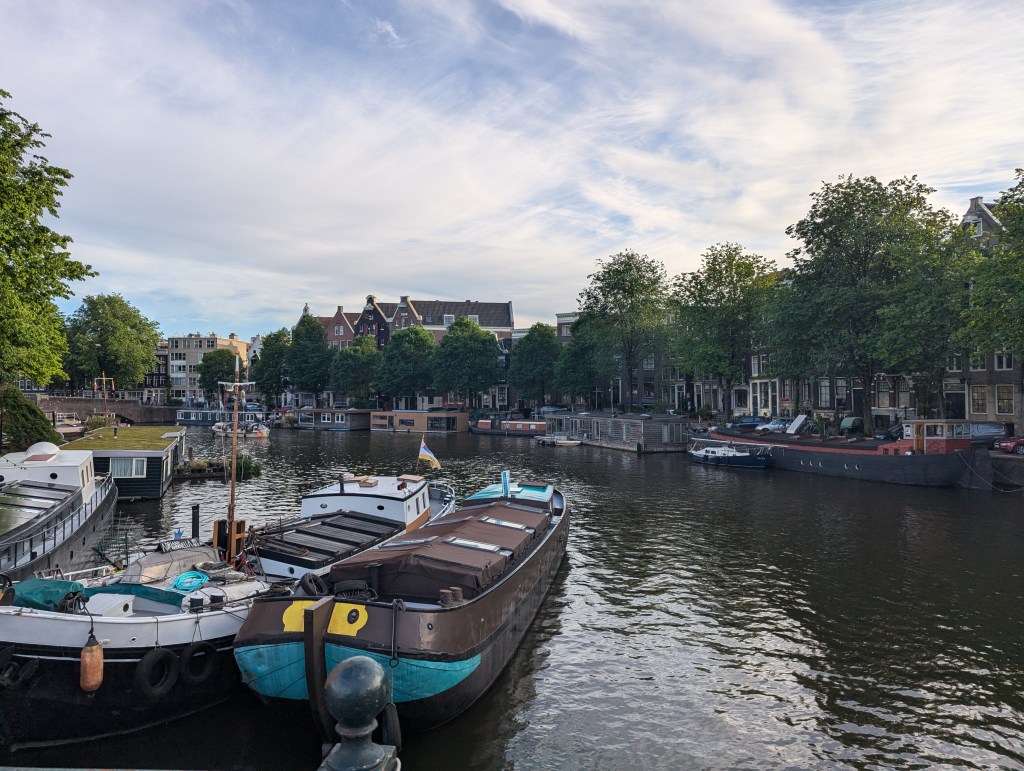
The canal tour was a really nice kick-off because it allowed us to run through pretty much the entire city and even gave us some ideas for things to see that we hadn’t considered before. We also took a second guided tour during the day, which was the Anne Frank Walking Tour. This was a tour through the Jewish Quarter of Amsterdam and pointed out areas where Anne Frank would have lived, played, and studied. It told the story of Amsterdam’s experience of WWII through the eyes of a young Jewish girl and was quite a moving way to experience the story. The tour ended right at the Anne Frank House, the building in which the Frank family and their friends hid during WWII before their eventual capture by the Nazis.
We timed it so that the tour landed us in front of the Anne Frank House, and left us just enough time for dinner before our entry time into the museum. This museum sells out fast, so make sure you buy your tickets well in advance. We bought our tickets the very day that tickets for our target date opened and could only manage an entry time of 8pm! Inside the museum, the building is quite bare with the majority of the furniture removed. Otto Frank, Anne’s father, set up the museum and left it barren intentionally so that people could see what was left of their hiding space when Otto regained his freedom after the war.
At the end of the museum, dioramas help you understand what the rooms would have looked like furnished. During your visit, an audio guide is included with your entry ticket and helps you follow the story of the Frank family and understand the purpose of each of their rooms, as well as hearing about some close calls they had during their time in hiding. It’s a harrowing experience and one that leaves you feeling a little bit haunted, with a large photograph of Anne looking down on you as you exit the building. Though the museum is small, it is absolutely worth a visit and the additional tour beforehand enhances the experience.
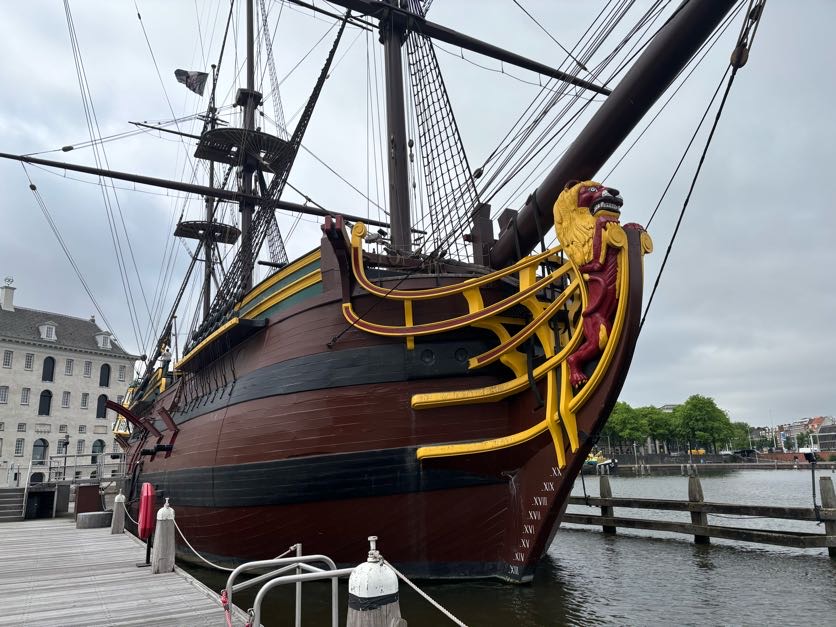
We took a rest that night to reset and launched into the next day to look at a more positive side of Amsterdam. We started with The National Maritime Museum, providing a view into the history of the Netherlands and the Dutch East India Company’s penchant for expansion during colonial times. The museum is very self-aware and also includes some exhibits around the history of whaling! We then walked over to the Hortus Botanicus, a botanical garden in Amsterdam which features a huge variety of plants and is laid out in a fashion that is very pleasant to walk around.
After some more wandering during daylight hours, we ended the day with a little wander through the Red Light District. Not my cup of tea to be frank, but it was an interesting view into a city that has taking a very unique approach to legislation around the “trade”, and has seemingly stripped it of a lot of its stigma. If you have the time and interest, you can take a walking tour before sunset or visit the Red Light District museum. If you’re like me and you just want to take a look at something unique to Amsterdam, wait until after dark and have a stroll around Oudekerkstraat and the two canals nearest this street. There are huge crowds of people that are clearly just there for the tourist experience, and most of our time in the Red Light District was spent navigating these crowds!
On our last full day in Amsterdam we focused in on the museums. We did the Rijksmuseum and Van Gogh Museum back-to-back, which was easy to navigate as these are located right next to each other. Afterwards, we made a point of visiting Vondelpark, which is known as the lungs of the city. This park was very enjoyable to wander around as it provided the feeling of being out of the city, while still having easy access to all the places we wanted to go. We spent a couple of hours in the park, and if we visit again would want to maybe bring some sandwiches and stop for a quick picnic.
Fueling Up:
The one thing you absolutely must try in Amsterdam is the stroopwaffel. We had these from multiple locations, but our favorite was Firma Stroop on Kalverstraat. In addition to stroopwaffel, Amsterdam has a whole lot of excellent food to try out. It’s a metropolitan city with populations from around the world, so think of it like being in New York City or Chicago for food. We had Thai food, Indonesian, and Italian, all of which were good quality options. It’s hard to make a specific recommendation for Amsterdam since there are so many amazing restaurants, but there are two that we particularly loved. For Italian food, we found Verona Ristorante Italiano on Reguliersdwarstraat. This whole street is lined with restaurants and features American, Italian, and multiple Asian cuisines. If you’re looking for a restaurant and don’t know what you want, this might be a good area to start.
We discovered while we were there that Indonesian food is particularly good in Amsterdam, given the history of Indonesia as a Dutch colony. Just around the corner from the Anne Frank house, Long Pura is a great stop for a filling meal and a view into Indonesian cuisine. If you’re sensitive to spice let them know ahead of time, because the food here seems to be quite authentic. Of course, I haven’t yet been to Indonesia, so I’ll keep you all posted once I’ve had the real thing!
Another must-see location is the Sea Palace, which is a massive floating restaurant originally constructed in the 80s. This restaurant posed some controversy in its early days when it was unable to support the number of people that came on board! It is perfectly safe however, and serves a truly delectable selection of Chinese dishes. All things considered, Amsterdam probably provided us with some of the best food we had on this trip. Don’t forget, there are also a ton of bakeries that you can find on any street which provide sugary snacks to fuel you on your journey if you’re feeling a little light-headed.
That’s a Wrap
So we did the thing. We made it back out to France and saw Versailles in the summer, explored 2 new countries we had never been to, and ate lots and lots of amazing food. This was an interesting trip for me because it was a less stringent itinerary than what I’m used to, but I found that as a result we actually managed to do more! I think all of the places we visited were worth our time and money, and some of these are absolutely going to warrant a re-visit. With 2 trips in 2025, we’re probably going to take a little breather from Europe for the time being, but stay tuned for our next adventure!
 Paper Cut Pages